

The corridor illusion in infrastructure planning

A route can look efficient in isolation and still be the wrong network decision.
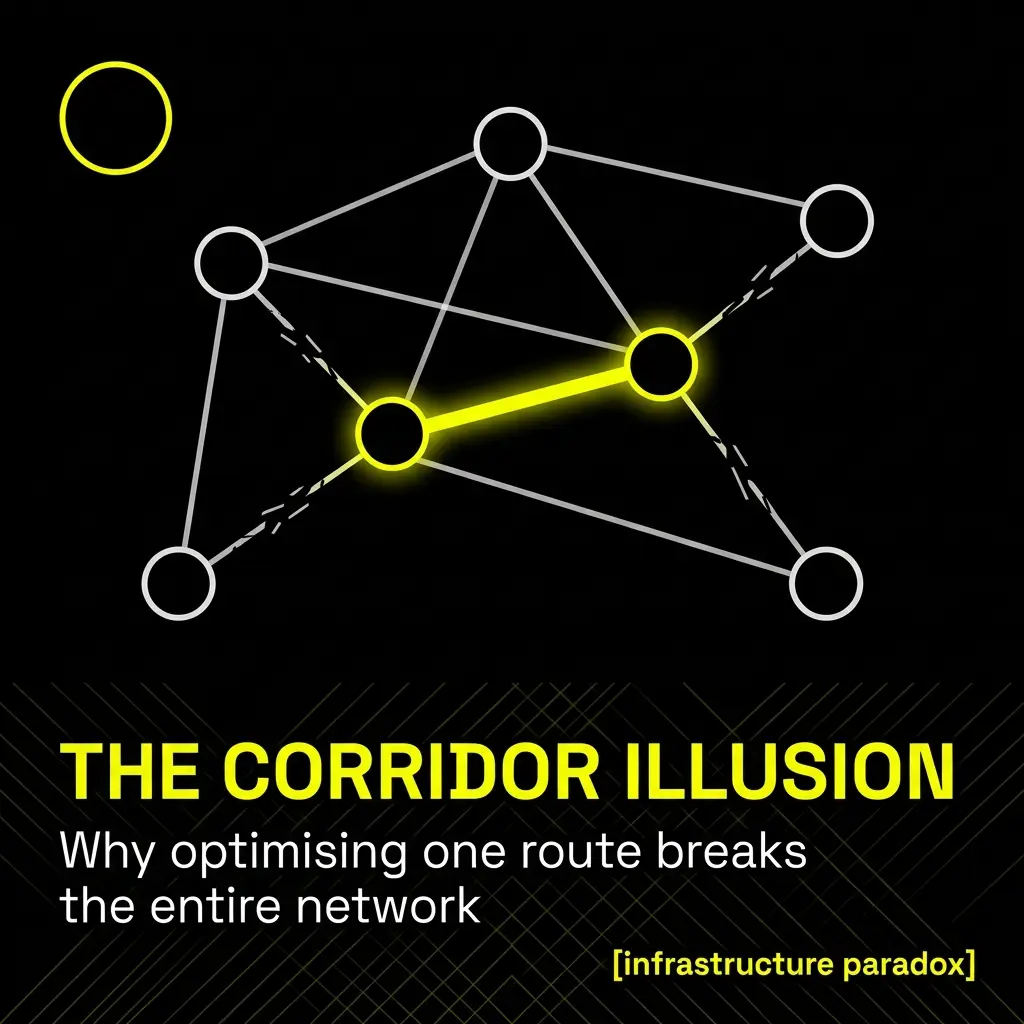
That is the corridor illusion in infrastructure planning. Teams compare an individual route, corridor or connection because it performs well against immediate constraints: cost, distance, land, environment, planning risk and buildability. But infrastructure does not operate as a set of isolated corridors. Routes interact with network topology, future demand, capacity constraints, phasing decisions and resilience requirements.
This does not mean corridor optimisation is wrong. It means corridor optimisation is incomplete unless the option is also tested against the wider network.
That distinction matters more as the UK accelerates energy and infrastructure delivery. New transmission, distribution, hydrogen, CCUS, heat, water and industrial connection projects are not just individual schemes. They are part of systems that need to absorb future demand, connect new assets, manage uncertainty and remain resilient as conditions change.
The planning challenge is no longer only “what is the best route?” It is also “what does this route do to the rest of the network?”
The warning from Braess’ paradox
Braess’ paradox is a useful warning from network theory. In a transport network, Dietrich Braess showed that adding a new route to a congested system can increase travel times when users independently choose what appears to be the fastest path. The new link looks helpful locally, but the changed network can perform worse as a whole.
The lesson is not that new infrastructure is bad. The lesson is that adding capacity can change flows, incentives and constraints in ways that are not visible when each corridor is assessed on its own.
The same kind of counter intuitive effect has been explored beyond roads. Research on power grids has shown that adding lines or increasing line capacity can, under some conditions, reduce overall system performance or increase instability risk. Natural gas network research has also examined how adding links can challenge the assumption that more connections always improve network performance.
These examples should not be treated as direct analogies across every infrastructure sector. Electricity, gas, water, heat and transport networks all behave differently. Physical flows, control systems, regulation, safety margins and operational rules matter. But the planning implication is still relevant: a new line, pipe, cable or connection should be tested not only as a project, but as part of a changing network.
Why local optimisation is not enough
Infrastructure planning often has to start with local questions. Which route avoids the most constraints? Which corridor is shortest? Which option has the lowest estimated capital cost? Which alignment looks easiest to consent?
Those questions are necessary. They are not sufficient.
A route that minimises cost today may reduce future expansion potential. A connection point that looks attractive now may create later reinforcement pressure. A corridor that avoids one visible constraint may concentrate risk elsewhere. A phasing decision that works for the first project may make the second and third projects harder to deliver.
This is where the corridor illusion becomes commercially important. The issue is not that specialists fail to understand their own discipline. The issue is that early route, site, connection and phasing decisions are often made before all network interactions are visible.
That creates path dependency. Once a route starts to align with reporting, surveys, stakeholder engagement, land work and internal governance, reopening the comparison becomes harder. The cost of changing direction increases, even if new evidence shows that another option may be more robust.
Efficiency, resilience and optionality
Efficiency and resilience often pull infrastructure design in different directions.
A highly efficient network may reduce distance, duplication and capital cost. A more resilient network may require pathway diversity, redundancy, spare capacity or alternative connection routes. Neither objective is automatically right. The right balance depends on the asset, operating conditions, future demand uncertainty and the consequences of failure.
Network research has explored this as a trade off between efficiency and resilience. Highly efficient topologies can minimise path length, while more resilient structures often depend on distributed connectivity and the avoidance of excessive dependence on critical links or nodes.
For infrastructure planners, the practical point is not academic. Early decisions need to make trade offs visible.
A low cost route may be acceptable if the network has other forms of flexibility. A more expensive route may be justified if it preserves future capacity, avoids a critical bottleneck or creates better optionality for later connections. A phased build may look slower in the short term but reduce overbuild risk if demand is uncertain.
The best option is rarely the shortest route in isolation. It is the option that performs best against the system objective, under uncertainty.
Cascading effects and interdependence
Infrastructure systems also fail and recover through interdependence.
A disruption in one asset can shift load, demand or operational pressure onto another. A local issue can become a wider system issue if alternative pathways are limited. UK infrastructure resilience material has long recognised that infrastructure components often depend on other systems, and that failure can propagate through chains of dependency.
This does not mean every local failure becomes a cascade. It means planning should test what happens when assumptions do not hold.
What happens if a connection is delayed?
What happens if a corridor becomes harder to consent?
What happens if demand appears in a different location?
What happens if a future reinforcement is brought forward?
What happens if one route becomes unavailable or politically difficult?
Corridor level planning can answer whether an individual route is viable. Network aware planning asks whether the wider system remains useful when conditions change.
That is a different level of question.
The coordination problem
There is also a governance issue.
Different actors optimise within their own project, regulatory and commercial constraints. A developer wants a viable connection. A network operator wants an efficient and secure system. A consultancy wants to produce a defensible recommendation for its client. A local authority wants impacts understood. Communities and landowners want to understand what infrastructure means for them.
Each actor can make a rational decision from its own perspective, while the combined outcome remains weaker than it could be.
This is not a failure of judgement. It is a coordination problem.
Without a shared evidence base, option comparison becomes fragmented. GIS constraints sit in one place. Engineering assumptions sit somewhere else. Cost estimates, land risk, environmental constraints, consenting issues and stakeholder evidence mature at different speeds. By the time those inputs are fully reconciled, the project may already be leaning towards an emerging preferred option.
That is why decision traceability matters. Planning teams need to understand not only which option was selected, but why it was selected, what assumptions drove the decision and what evidence would change the recommendation.
What systems level planning requires
Systems level planning does not mean abandoning corridor optimisation. It means asking better questions earlier.
Which option performs best under today’s constraints?
Which option remains useful if demand grows differently?
Which connection point preserves future capacity?
Which route creates the least delivery risk once land, consenting and stakeholder factors mature?
Which corridor becomes critical under stress?
Where does a low cost option reduce future flexibility?
Which phasing sequence gives the network the best strategic optionality?
Answering those questions requires a different planning workflow.
First, teams need to compare option sets, not just individual routes. The useful output is not one line on a map. It is a portfolio of credible options, with clear evidence on why each option performs differently.
Second, teams need to test options across multiple evidence layers. Cost, engineering feasibility, buildability, land, environment, consenting, stakeholder sensitivity, future capacity and phasing should be compared together, not assembled after the preferred option has already started to form.
Third, teams need to preserve the evidence trail. When a recommendation is challenged, the team should be able to show which constraints were considered, what assumptions were used, what trade offs were made and why certain options were selected, rejected or retained.
Fourth, teams need to test scenarios. A route that works under one demand forecast, project sequence or constraint weighting may perform poorly under another. Scenario testing makes those sensitivities visible before decisions harden.
The planning software gap
Many planning workflows still focus on project scale option comparison, while wider network interactions are handled separately or later in the process.
That separation is understandable. Infrastructure planning is complex. Different disciplines use different tools, datasets, assumptions and reporting formats. No single model should replace professional judgement across engineering, planning, environmental assessment, consenting or land strategy.
But the current workflow creates friction. Teams spend time moving evidence between GIS files, spreadsheets, reports, cost models and review meetings. Options are compared unevenly. Assumptions become hard to track. Rework increases when new evidence arrives after the decision process has narrowed.
The software gap is not simply route generation. It is structured option comparison.
Planning teams need tools that help them generate, compare and refine route, connection, network and phasing options across the evidence that actually drives infrastructure decisions. They need software that supports judgement, not software that pretends to replace it.
Moving beyond the corridor illusion
The answer is not to stop optimising routes. The answer is to stop treating routes as isolated decisions.
Infrastructure planning needs corridor level detail and network level context. The strongest option is not always the shortest, cheapest or most efficient in isolation. It is the option that performs best across the wider system, under uncertainty, before decisions become expensive to change.
That means testing more options earlier.
It means making trade offs explicit.
It means understanding how route choices affect future network capacity, resilience and delivery risk.
It means building an evidence base that can survive internal review, stakeholder challenge and later project development.
The corridor illusion breaks when planning teams recognise that network value comes from interactions, not individual routes alone.
For the next generation of energy and infrastructure delivery, that distinction will matter.


Start building today
