

Pre FEED Infrastructure Routing Platform for Early Stage Option Development

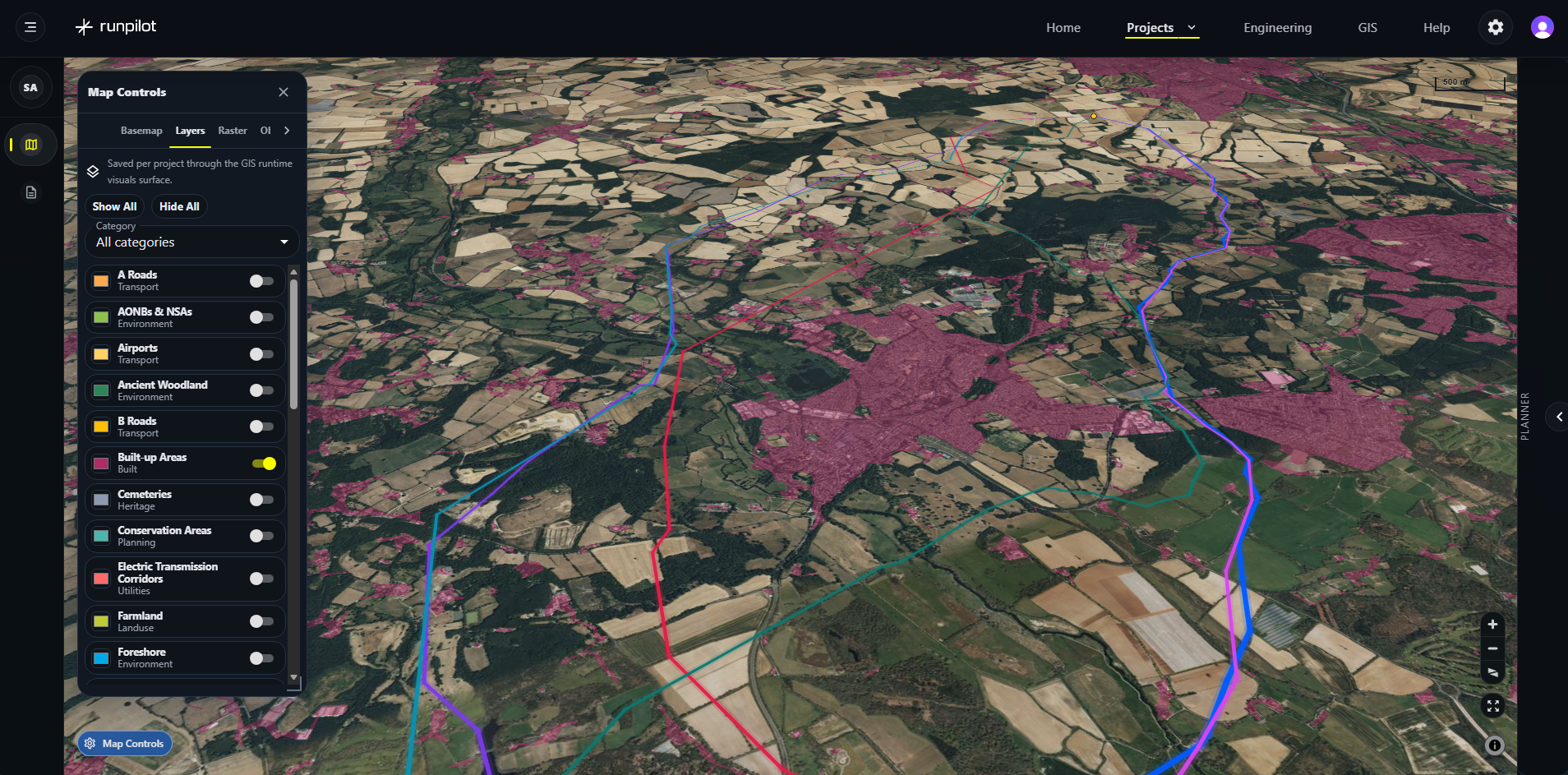
Infrastructure planning teams face a structural problem during early-stage option development. The work happens when demand projections remain uncertain, policy frameworks shift, and stakeholder opposition patterns haven't fully emerged. Yet decisions made during initial feasibility and concept design determine which options progress to detailed design, which routes get surveyed, and where capital gets committed.
The process demands iteration. Assumptions change. Load growth forecasts get revised. Consenting risks surface. Land constraints appear. Each change triggers a cascade of rework across GIS layers, cost models, and technical reports.
This isn't a software problem that existing tools solve poorly. It's a workflow problem that most infrastructure planning platforms weren't designed to address. The bottleneck isn't route generation itself, but the slow recombination of GIS data, constraints, cost models, risk registers and evolving assumptions during early option development.
Where Manual Processes Create Friction
During outline and concept design stages, teams compare multiple route options against evolving constraints. A network planner at a DNO might evaluate five potential reinforcement routes to support anticipated load growth. An infrastructure consultant working on transmission projects could be testing ten corridor options across different landfall locations. A water utility asset team might be comparing pipeline routes under three demand scenarios.
The analysis itself isn't the bottleneck. Teams already conduct environmental screening, perform initial cost estimates, and assess consenting risk. The friction emerges when assumptions change and the entire comparison needs updating.
A revised demand forecast means recalculating capacity requirements. A new environmental constraint means rerouting through different land parcels. A stakeholder objection means testing alternative corridors. Each iteration requires pulling together outputs from multiple specialist tools, updating GIS layers manually, revising cost models in spreadsheets, and regenerating reports for internal review.
The time lag between "we need to test this assumption" and "here's the updated comparison" can stretch from days into weeks. During Pre-FEED and early concept development, when options remain open and strategic questions still matter, that lag prevents teams from exploring the scenarios that would inform better decisions.
What Makes Pre-FEED Routing Different
Detailed design works within progressively defined parameters. The route is substantially determined, though surveys, ground conditions, land access and constructability work can still expose issues that require refinement. The strategic questions about which corridor to pursue have largely been answered.
Pre-FEED operates in a different regime. You're testing whether a route is viable before committing to detailed analysis. You're comparing options to determine which ones warrant further investigation. You're integrating outputs from environmental screening, initial consenting assessment, and high-level cost estimation to build an evidence base that supports option selection.
The challenge isn't performing each specialist analysis in greater detail. Environmental consultants already conduct desk-based screening, ecological appraisal, and where appropriate, field surveys. Cost estimators already apply rate cards. Consenting specialists already assess planning risk. The challenge is integrating those outputs quickly enough that teams can test alternative scenarios whilst options remain open.
Manual integration creates a structural delay. When you receive updated environmental constraints as a PDF report, revised cost estimates in a spreadsheet, and consenting risk commentary in an email thread, synthesising that information into a comparable option assessment requires manual coordination across multiple tools and formats.
The Role of Iteration Speed
Infrastructure planning under uncertainty requires testing assumptions systematically. A transmission owner evaluating offshore cable routes needs to compare options under different landfall locations, cable ratings, and consenting risk profiles. A water utility planning network expansion needs to test routes under varying demand growth scenarios and phasing sequences.
The value isn't keeping all options open indefinitely. It's narrowing options based on evidence whilst the decision still matters. If testing an alternative scenario requires significant manual rework, teams default to fewer iterations and make option selections with less evidence than the decision warrants.
Faster iteration doesn't mean rushing decisions. It means testing more scenarios systematically, incorporating updated constraints as they emerge, and building confidence in option selection through structured comparison rather than intuition.
How Automation Fits Into Pre-FEED Workflows
Automation in infrastructure routing doesn't replace specialist analysis. Load flow studies, thermal modelling, and fault level analysis require domain expertise and regulatory compliance that generalist platforms can't replicate. Environmental impact assessment, detailed consenting strategy, and stakeholder engagement require human judgement that software shouldn't attempt to automate.
The automation opportunity exists in the integration layer. When environmental constraints, cost data, consenting risk, and technical requirements are structured as testable inputs, route comparison becomes partly computational rather than purely a manual coordination exercise. The computation provides the structured evidence base. Professional judgement, stakeholder strategy, risk appetite and deliverability assessment remain human decisions.
A network planner testing reinforcement options can update demand assumptions and regenerate route comparisons more rapidly. An infrastructure consultant comparing transmission corridors can incorporate new environmental constraints and see how comparative decision support outputs shift. A utility asset team can test phasing sequences under different demand scenarios with reduced manual rework across cost models.
Automated route option generation and comparison integrates outputs from specialist analysis into a framework where assumptions can be tested systematically and results remain auditable. Environmental screening data becomes a routing constraint. Consenting risk assessments become weighted factors. Cost estimation models become inputs that update when route parameters change, with version control and assumptions registers maintained throughout.
What Structured Integration Enables
When specialist outputs integrate into a shared decision environment with proper data provenance and model governance, iteration speed can increase substantially. Teams can test strategic questions that manual processes make prohibitively slow: Should you prioritise least-cost routing or fastest consenting pathway? Does phasing reduce overall risk? How does stakeholder opposition change corridor selection?
The platform produces decision support outputs: route options mapped against constraint layers, comparative cost ranges, consenting risk scores, documented assumptions registers, scenario logs, and comparison tables. Output quality depends on input data quality, agreed weighting logic, and appropriate expert review. The system supports a defensible recommendation. It doesn't make the final decision.
Governance Frameworks and Implementation Stages
Early-stage option development encompasses various governance frameworks depending on sector and client requirements. This work often maps to RIBA Stage 1 (Preparation and Briefing) and Stage 2 (Concept Design) in building-focused projects, Pre-FEED in engineering and energy infrastructure, or client-specific feasibility and concept stages in utilities and transmission planning.
During initial feasibility work, teams identify project requirements, establish viability, and determine initial constraints. Routing work at this stage involves high-level corridor identification, desk-based environmental screening, and initial cost estimation to support business case development. Where RIBA Stage 1 applies, guidance notes that feasibility studies can test whether requirements can be accommodated, but where multiple options are feasible, they should typically not be narrowed down at this stage.
Structured integration enables more systematic comparison of strategic alternatives. Instead of manually testing a limited number of corridor options, teams can evaluate a broader set. Instead of assuming a single demand scenario, teams can test sensitivity across multiple projections.
During concept design (RIBA Stage 2 where applicable, or equivalent stages in infrastructure governance), teams develop options in greater detail, conduct more rigorous environmental assessment, refine cost estimates, and begin stakeholder engagement. Routing work involves comparing specific route alignments within selected corridors, incorporating detailed constraints, and preparing evidence that will support subsequent planning applications and investment decisions.
As analysis deepens, integration maintains consistency and traceability. When environmental consultants provide updated ecological data from existing datasets, GIS, EIA workflows or survey outputs, that information integrates into route comparison models with documented provenance. When cost estimators refine unit rates, models update across route options with version control. When consenting specialists identify new planning risks, those constraints feed into option assessment with an auditable trail.
Environmental consultants still conduct desk-based screening, preliminary ecological appraisal, and where appropriate, survey work. The difference is that outputs from existing GIS, CAD, BIM or EIA systems can integrate into routing models as structured constraints with clear data provenance, rather than remaining solely in narrative reports that require manual interpretation for each iteration. Cost estimators still build detailed estimates. The difference is that calculation logic becomes reviewable and estimates update when route parameters change. Consenting specialists still assess planning risk. The difference is that risk assessments become weighted factors with documented rationale rather than qualitative commentary interpreted subjectively.
Supporting Evidence Requirements and Decision Gates
Infrastructure projects progress through defined decision gates. Initial feasibility stages establish project viability and secure funding. Concept design stages define preferred options and support subsequent detailed planning, consenting and investment decisions.
Each gate requires evidence that demonstrates due diligence. Teams must show they've considered reasonable alternatives, assessed environmental and social impacts, estimated costs with appropriate confidence levels, and identified key risks.
Automated route option generation and comparison platforms support evidence requirements by creating an auditable record of option development. Every scenario tested, every constraint applied, every assumption changed, and every weighting factor adjusted gets logged with version history. When project teams present option comparisons to governance boards or regulators, the analysis becomes reproducible, the methodology transparent, and the decision logic defensible.
This matters because infrastructure decisions face increasing scrutiny. Stakeholders challenge route selection. Regulators question whether alternatives were adequately considered. Planning authorities require evidence that environmental and social impacts were systematically assessed.
Manual processes struggle to maintain that level of documentation systematically. When option development happens across disconnected tools and involves multiple team members, reconstructing the decision logic and confirming which constraint sets were applied to which options becomes difficult.
Structured platforms maintain consistency through embedded workflows. The same constraint sets apply to compared options. The same methodology evaluates scenarios. Assumptions registers, sensitivity testing, and QA checkpoints become embedded rather than manual additions.
Implementation Approach
Adopting automated route option generation during Pre-FEED doesn't require replacing existing workflows wholesale. The integration happens incrementally.
Teams start by structuring constraints they already use. Environmental screening data from PDF reports, GIS layers or EIA databases gets integrated as structured spatial constraints. Consenting risk assessments from narrative commentary or risk registers get translated into weighted factors with documented rationale. Cost estimation models from spreadsheets or client systems get formalised into calculation engines with version-controlled assumptions.
Once constraints are structured with appropriate governance, comparison workflows become repeatable and auditable. Teams define parameters, specify objectives, and generate options. The platform handles computational work whilst maintaining human oversight. Specialists review outputs, refine constraints based on professional judgement, and iterate with full traceability.
Integration With Existing Tools
Infrastructure teams already use specialist software for network analysis, environmental assessment, and cost estimation. Automated route option generation platforms don't replace those tools. They integrate outputs into a shared decision framework.
Load flow studies from specialist power systems software provide capacity constraints. Environmental screening from GIS platforms, EIA tools or consultant analysis provides exclusion zones and weighted factors. Cost estimation models from spreadsheets, client databases or rate libraries provide unit rates and calculation logic.
The platform becomes the integration layer where specialist outputs combine into testable scenarios with model governance and audit trails. Teams continue using trusted tools for specialist analysis whilst gaining capability for more systematic option comparison during Pre-FEED.
Where This Matters
Infrastructure planning faces increasing pressure to deliver faster whilst maintaining rigorous analysis standards. Automated routing during Pre-FEED addresses that tension by removing the structural delays that manual integration creates.
Teams gain ability to test more scenarios systematically, incorporate evolving constraints with traceability, and build stronger evidence bases within existing project timelines. Specialist expertise remains central. Specialist outputs integrate into decision frameworks that support structured, auditable comparison.
The return can be measurable where iteration currently creates bottlenecks: faster option testing during early development, stronger evidence supporting decision gates, greater confidence that selected options reflect systematic analysis rather than the limitations of manual coordination.
Where is your team losing time to repeated option comparison, assumption updates, and evidence reconstruction? Identify whether structured integration can support faster, more auditable iteration whilst maintaining the specialist expertise and professional judgement your projects require.


Start building today
